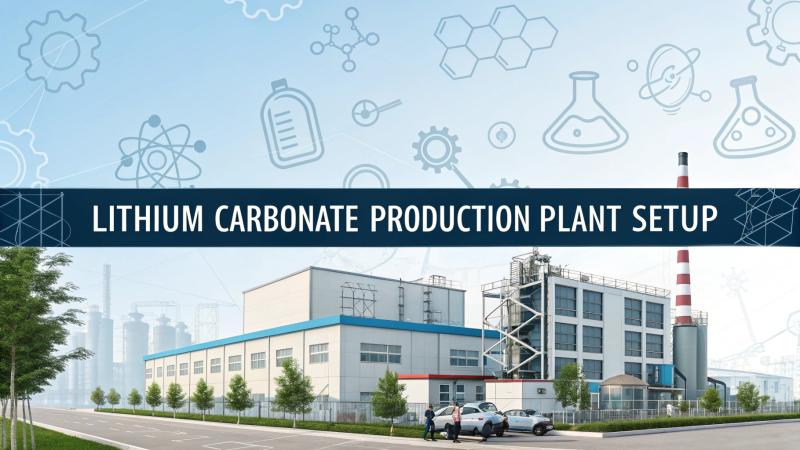
Setting up a lithium carbonate production facility involves selecting an appropriate manufacturing method, such as: B. the extraction from lithium-containing brines by solar evaporation and chemical precipitation or the processing of spodumene ore from hard rock by roasting and acid leaching with subsequent cleaning and carbonization, securing the supply of raw materials from brine operations or spodumene mining, the installation of evaporation ponds or roasting ovens, precipitation reactors, filter and washing systems, drying systems and comprehensive quality control facilities as well as ensuring the Compliance with environmental regulations, mining permits and battery purity specifications.
IMARC Group's report titled “Lithium Carbonate Production Cost Analysis 2025: Industry Trends, Plant Setup, Machinery, Raw Materials, Investment Opportunities, Cost and Revenue” provides a complete roadmap for setting up a lithium carbonate production facility. It includes a comprehensive market overview down to micro-level information, e.g. E.g. operations involved, raw material requirements, supply requirements, infrastructure requirements, machinery and technology requirements, personnel requirements, packaging requirements, transport requirements, etc.
Request a sample report: https://www.imarcgroup.com/lithium-carbonate-manufacturing-plant-project-report/requestsample
What is Lithium Carbonate?
Lithium carbonate is an inorganic chemical compound with the formula Li2CO3, which is widely used as an important raw material in the lithium industry. It exists as a white, odorless, crystalline powder that is very stable and easily soluble in water. Lithium carbonate plays a critical role in the production of lithium-ion batteries that power electric vehicles, smartphones, laptops and energy storage systems. It is also used in medications to treat bipolar disorder and in ceramics and glass manufacturing to improve strength and heat resistance. Due to rapid technological advances, lithium carbonate has become essential for clean energy applications and the global shift towards sustainability.
What drives lithium carbonate production?
Lithium carbonate production is primarily driven by the rapid growth of the electric vehicle (EV) industry, which relies heavily on lithium-ion batteries for its long-range performance and efficient energy storage. The increasing adoption of renewable energy systems – including solar and wind energy – requires advanced battery storage technologies and increases lithium consumption worldwide. Government policies aimed at decarbonization, sustainability and reducing dependence on fossil fuels are further accelerating demand for lithium carbonate. In addition, the continued expansion of consumer electronics such as smartphones, tablets and wearable devices significantly increases the pressure on the lithium supply chain. Technological innovations in battery chemistry and recycling as well as increasing investments in mining and processing facilities are enabling increased production capacities. In addition, growing demand from the aerospace, medical technology, and glass and ceramics industries is contributing to market expansion. As countries advance electrification and greener infrastructure, lithium carbonate remains a strategic material for future energy and transportation solutions.
Buy now: https://www.imarcgroup.com/checkout?id=10048&method=2142
Important insights for setting up a lithium carbonate production plant
Detailed process flow
• Product overview
• Unit operations involved
• Mass balance and raw material requirements
• Quality assurance criteria
• Technical testing
Project details, requirements and costs involved:
• Property, site and site development
• Plant layout
• Machine requirements and costs
• Raw material requirements and costs
• Packaging requirements and costs
• Transportation requirements and costs
• Supply requirements and costs
• Personnel requirements and costs
Analysis of capital expenditure (CapEx) and operating expenditure (OpEx):
Project economics:
• Capital investments
• Operating costs
• Spending forecasts
• Sales forecasts
• Taxation and depreciation
• Profit forecasts
• Financial analysis
Profitability analysis:
• Total income
• Total expenses
• Gross profit
• Gross margin
• Net profit
• Net margin
Important cost components
• Land and site development: For brine operations – extensive construction of evaporation ponds in dry climates (over 1,000 hectares), foundations for processing plants; For the infrastructure of hard rock crushing plants, roasting oven foundations, the integration of acid plants and residue management systems.
• Machinery and equipment: Brine route: pumping systems, evaporation pond infrastructure, precipitation reactors, filter systems, centrifuges, spray dryers, micronization devices, DLE systems (emerging); Hard Rock Route: crushing and grinding mills, rotary spodumene roasting kilns (1,050-1,100 °C), acid leaching tanks, solvent extraction units, precipitation tanks, calcination furnaces, quality control laboratories (ICP-MS, XRF).
• Civil and civil engineering works: evaporation pond construction and lining, chemical resistant processing facilities, high temperature equipment foundations, tailings pond dams (hard rock), water management infrastructure, utility installation.
• Environmental Compliance: Water management and recycling systems, brine discharge treatment, tailings management facilities, air emissions controls for roasting operations, dust suppression systems, environmental monitoring programs and regulatory approvals.
• Technology Licensing or Research and Development: DLE technology licensing, proprietary purification processes, battery quality improvement methods, spodumene processing technologies, or internal process optimization programs.
Economic trends influence the cost of building a lithium carbonate plant in 2025
• Electric vehicle revolution: The explosion of electric vehicles worldwide (expected to represent 30-40% of new vehicle sales by 2030) is driving unprecedented growth in lithium demand, justifying massive capital investment despite high setup costs.
• Resource availability and competition: Limited high-grade lithium resources (brine deposits in the “lithium triangle” of South America, hard rock in Australia, emerging resources in Africa and North America) lead to intense competition for high-quality reserves.
• Technology transition to DLE: Direct lithium extraction technologies promise faster production (weeks versus 12-18 months for evaporation), lower water consumption and lower land requirements – but require higher capital expenditure and are still being scaled up commercially.
• Battery-grade purity requirements: Stringent specifications for battery applications (>99.5% purity, low heavy metals, controlled particle size) require advanced purification infrastructure that goes beyond traditional industrial-grade production.
• Impact on energy costs: Hard rock processing (energy-intensive roasting at 1,050°C) makes facilities very sensitive to electricity and natural gas prices and favors locations with access to renewable energy.
• Supply chain bottlenecks: The lack of qualified engineers, specialist equipment (roasters, DLE systems) and experienced personnel is leading to project delays and cost increases in this fast-growing sector.
• Price volatility: Lithium carbonate prices, which have ranged between US$15,000 and US$80,000 per tonne in recent years, create challenges in financial modeling and complexity in assessing risk in long-term investments.
Request for a custom report: https://www.imarcgroup.com/request?type=report&id=10048&flag=E
Challenges and considerations for investors
• Exceptional capital investments: Lithium carbonate plants are among the most capital-intensive chemical plants – brine operations require $300-$800 million, hard rock operations $500-$1.5 billion and more depending on capacity and level of integration.
• Long development period: Brine operations require 3-5 years from exploration to production (including 12-18 months of evaporation), hard rock projects require 4-6 years, resulting in longer periods before revenue is generated.
• Resource risk and reserve uncertainty: Geological uncertainties in brine composition, fluctuations in lithium concentration and consistency of hard rock ore content impact production planning and economics.
• Extreme price volatility: The lithium carbonate market experiences boom-bust cycles with prices fluctuating by five to six times, leading to revenue uncertainty despite the long-term growth path.
• Environmental and social licensing: Dryland water use, tailings management, indigenous land rights and community impacts create licensing issues and operational limitations.
• Evolving quality specifications: The evolution of battery chemistry (LFP, NMC, solid state) may change the specifications and demand patterns of lithium compounds and require production flexibility.
• Geopolitical considerations: Resource nationalism, export restrictions, strategic mineral designations and supply chain security concerns impact investment risk and market access.
About Us:
IMARC Group is a global management consulting firm that helps the world's most ambitious changemakers achieve lasting impact. The company excels at understanding its customers' business priorities and delivering tailored solutions that drive meaningful results. We offer a comprehensive range of market entry and expansion services. Our offerings include in-depth market assessment, feasibility studies, business startup assistance, factory setup assistance, regulatory approvals and license navigation, branding, marketing and sales strategies, competitive landscape and benchmarking analysis, pricing and cost research, and procurement research.
Contact us:
IMARC Group
134 N 4th St. Brooklyn, NY 11249, USA
Email: sales@imarcgroup.com
Tel. No.: (D) +91 120 433 0800
United States: (+1-201971-6302)
This press release was published on openPR.